In health and social care, language skills have a direct bearing on the quality of the service and on client safety, yet everyday language is not always enough in the reality of the work. AliceAI Learning® is a mobile app that teaches professional Finnish for the needs of health and social care. Lyhty ry, a short-term home and workshop in Helsinki, was among the first to join the pilot, both to support the app's development and to help its international care staff learn Finnish.
Lyhty in brief
Lyhty ry is a non-profit association founded in 1993 whose work centers on promoting the wellbeing of people with intellectual disabilities. Lyhty provides housing services, daytime activities, and cultural and leisure activities. Its staff include nurses and support workers, some of whom come from international backgrounds and are learning Finnish alongside their work.
Supporting language learning before the pilot
At Lyhty, language learning has been supported through individual and unit-level arrangements, such as language courses and teachers hired as needed. Much of the learning has also taken place through everyday work. AliceAI Learning gave Lyhty an opportunity to help develop and test an app that could meet the language learning needs of international health and social care professionals.
Lyhty wants to support its staff
Christiane Schiemer, who oversees Lyhty's housing services and staff development, has worked at Lyhty for 26 years. A nurse by training, she understands the practical importance of language skills: “If language makes it difficult to manage the bigger picture, it can be harder to develop your skills and reach your full potential.” When AliceAI Learning offered the opportunity to take part in a pilot, the management team took it. “Why not? Let's try it,” Schiemer sums up.
Schiemer admits she was nonetheless the most skeptical about the idea: “I was probably the most critical at the start. I recognized my tendency to think that at a product's pilot stage the added value may lie not so much in the product as in developing it. That left me wondering at what point it is wisest to get involved — perhaps only once the product has been developed further.” What settled it was the benefit and the will to develop. Staff get to learn in the middle of their working day, without absences for external training, for instance. The product had also been developed far enough to be worth trying. And the message to the staff was clear: Lyhty wants to support its people.
The app helped staff manage everyday situations in the workplace
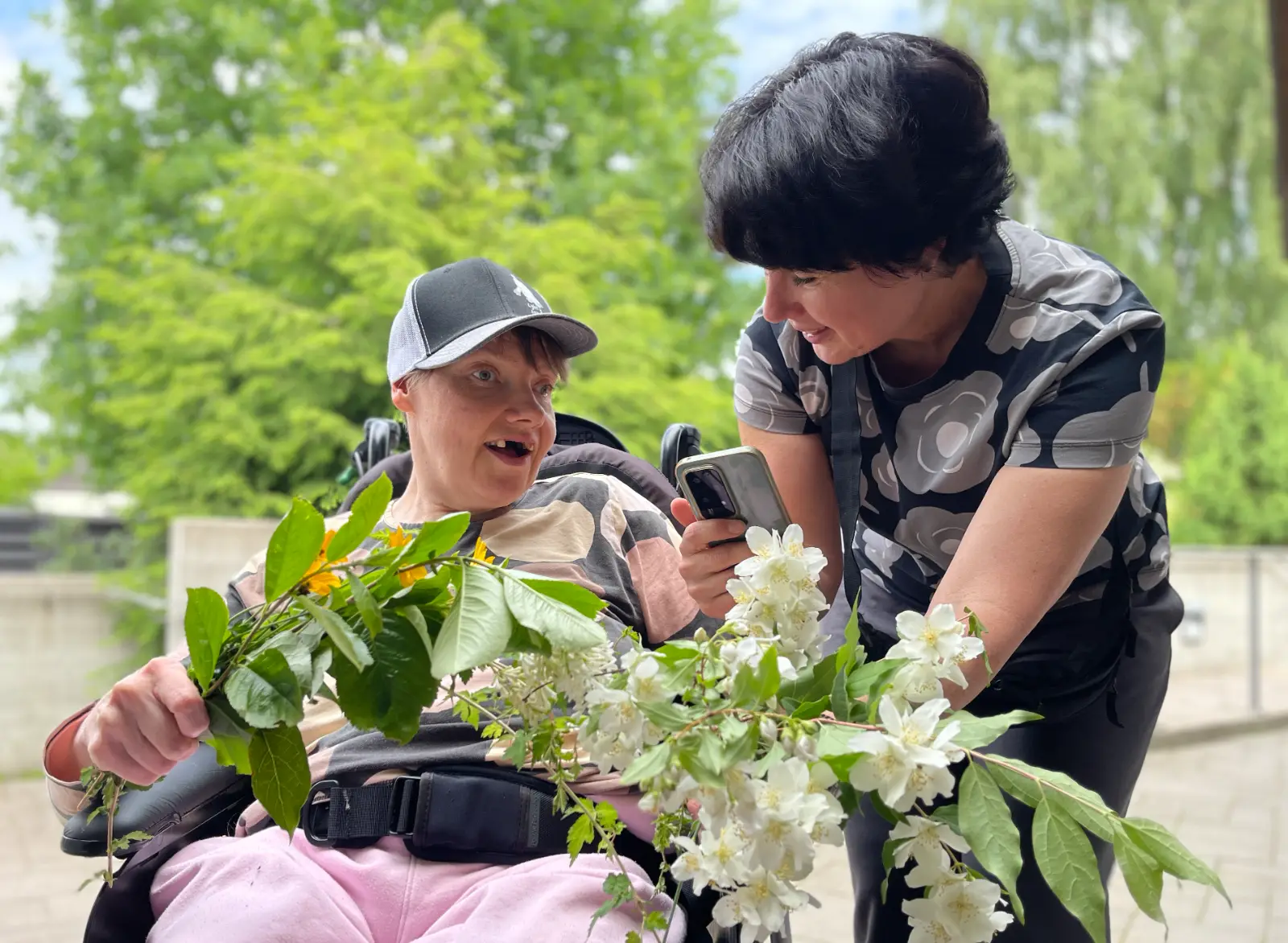
Five employees took part in the pilot, with widely varying initial levels of Finnish proficiency. The group included people trained as nurses and practical nurses, as well as one physiotherapist. Schiemer also used the app herself, hopefully setting a good example for staff as a member of the management team. The nurses gave immediate feedback. They praised the vocabulary and sentence structure exercises and highlighted the storytelling, which made learning more interesting. The health and social care terminology was a pleasant surprise. The app also helped them manage everyday situations in the workplace.
Results of the six-week pilot
The pilot ran for six weeks, and the results showed clearly how much motivation matters. The two nurses who practiced the most improved markedly. “One became so enthusiastic that they even studied Finnish with a family member,” Schiemer says. Most importantly, the pilot gave Lyhty a range of ways to support their staff's development. It also showed the staff concretely that their development matters.
Recommended for health and social care
Schiemer recommends AliceAI Learning to any health and social care organization recruiting employees whose Finnish is still at an early stage. “It offers a safe environment for language learning and is designed specifically for the needs of health and social care,” she says of the app. Schiemer also mentions that she values the fact that the app was developed in Finland. Lyhty is grateful for the chance to have been involved at the development stage. “It has been a pleasure to see what has been in the making,” Schiemer says.
